


CARF and CRS Amendments Consultation Opens in Hong Kong
Mandatory Registration and Penalty Escalation Signal Stricter Compliance Regime
December 17, 2025
Introduction
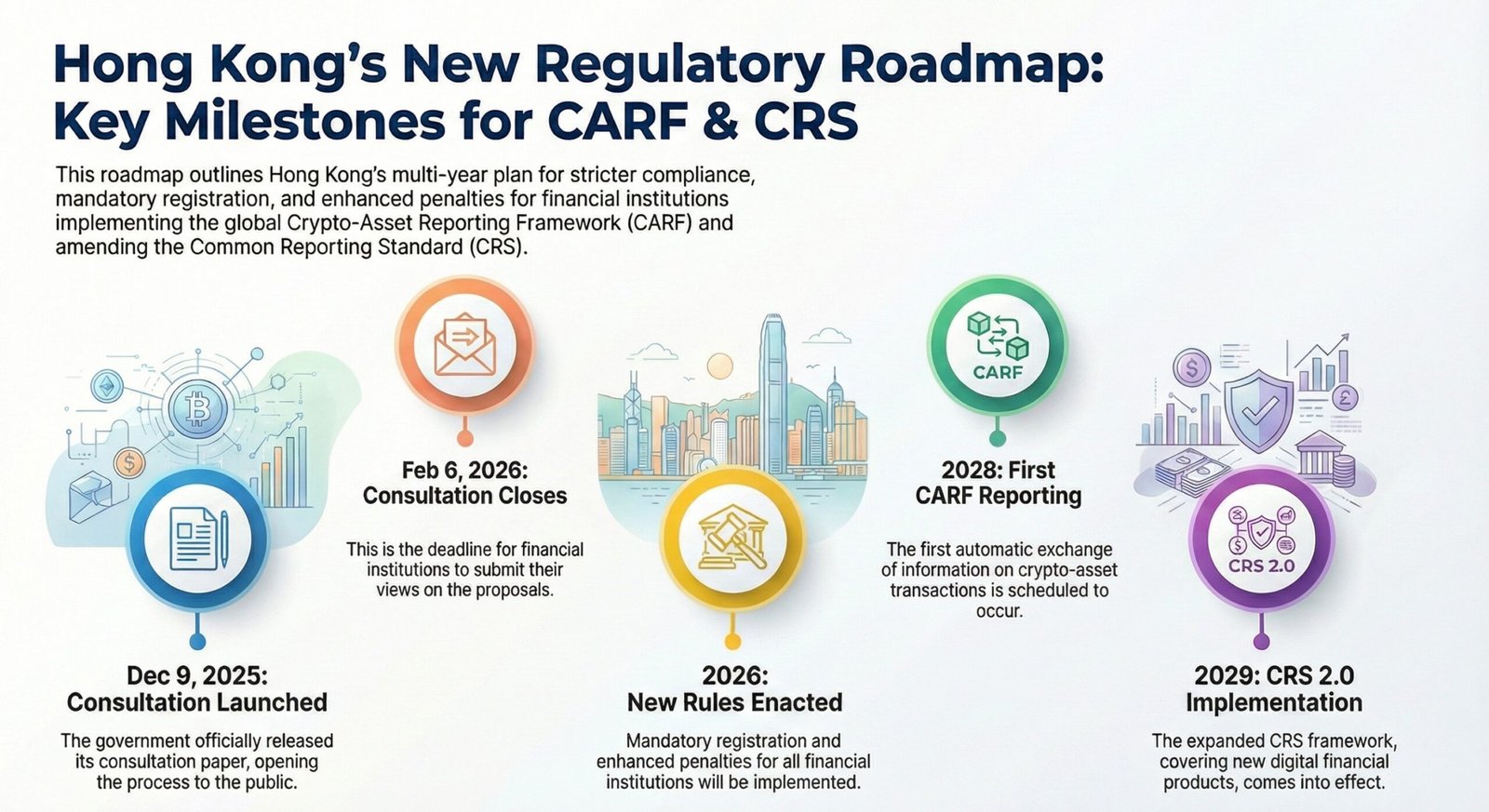
The Hong Kong government has officially launched a public consultation on the implementation of the Crypto-Asset Reporting Framework (CARF) and significant amendments to the Common Reporting Standard (CRS), signaling a decisive move to align with global tax transparency standards and tighten regulatory oversight of the financial sector [1]. The consultation paper, released on December 9, 2025, outlines a series of proposals that will have profound implications for financial institutions (FIs) operating in the jurisdiction.
Beyond the much-anticipated adoption of CARF, the introduction of mandatory registration for FIs and a clear intention to escalate penalties for non-compliance represent a fundamental shift in Hong Kong’s regulatory posture. For compliance leaders and risk managers, this is a critical moment that demands immediate attention and strategic planning.
This analysis will dissect the key components of the consultation, explore the underlying drivers for these changes, and provide a cross-jurisdictional comparison to contextualize Hong Kong’s evolving regulatory landscape. We will also examine the practical implications for FIs and offer actionable recommendations for navigating this new era of compliance.
The Core Proposals: What’s on the Table?
The consultation paper lays out a comprehensive roadmap for enhancing tax transparency in Hong Kong. The key proposals can be summarized as follows:
| Proposal | Description | Proposed Timeline |
|---|---|---|
| CARF Implementation | Adoption of the OECD’s framework for the automatic exchange of information on crypto-asset transactions. This will require Reporting Crypto-Asset Service Providers (RCASPs) to conduct due diligence and report on their users’ crypto transactions. | First information exchange by 2028 |
| CRS Amendments (CRS 2.0) | Expansion of the CRS to include new digital financial products, such as specified electronic money products and central bank digital currencies, ensuring that the CRS framework keeps pace with financial innovation. | Implementation starting 2029 |
| Mandatory FI Registration | A new requirement for all FIs, including those currently considered Non-Reporting Financial Institutions, to register with the Inland Revenue Department (IRD). This will provide the IRD with a comprehensive and up-to-date overview of all entities within its regulatory purview. | To be implemented in 2026 |
| Enhanced Penalties & Enforcement | A clear intention to raise the penalty levels for non-compliance with CRS and CARF obligations and to strengthen the IRD’s enforcement powers. The specifics of the new penalty structure are a key subject of the consultation. | To be implemented in 2026 |
The consultation period is open until February 6, 2026, with the government aiming to pass the necessary legislative amendments to the Inland Revenue Ordinance (Cap. 112) within the same year [1].
In-Depth Analysis: The Drivers Behind the Shift
These proposals are not being introduced in a vacuum. They are the result of a confluence of international pressure, evolving global standards, and a desire to safeguard Hong Kong’s reputation as a premier international financial center. Two key drivers stand out:
1. The OECD Peer Review Pressure
Since 2024, Hong Kong has been undergoing the second round of the OECD’s peer review on the effectiveness of its administrative framework for implementing the CRS [1]. While Hong Kong’s initial legal framework for CRS was deemed compliant, this second-round review focuses on practical implementation and effectiveness.
The introduction of mandatory registration and enhanced penalties is a direct response to the OECD’s evolving expectations and a proactive measure to ensure a favorable rating. A negative peer review finding could have serious reputational consequences, potentially impacting Hong Kong’s standing in the global financial community. This demonstrates a clear trend: international reputational concerns are increasingly being translated into concrete domestic compliance obligations.
2. Mandatory Registration as a Gatekeeping Mechanism
The proposal for mandatory FI registration is perhaps the most significant structural change outlined in the consultation. It marks a shift from a reactive to a proactive regulatory approach. Currently, the IRD relies on FIs to self-identify their reporting obligations.
A mandatory registration system will provide the IRD with a complete and real-time database of all FIs, enabling it to monitor compliance more effectively and to identify and pursue non-compliant entities more easily. This represents a fundamental tightening of the regulatory net, leaving no room for ambiguity or non-participation.
Penalty Escalation: A Global Trend
The consultation’s emphasis on raising penalty levels aligns with a global trend towards stricter enforcement of tax transparency standards. While the exact penalty amounts for Hong Kong are yet to be determined, a look at other jurisdictions provides a clear indication of the direction of travel:
- United Kingdom: The UK’s tax authority, HMRC, has a well-defined penalty regime for CRS non-compliance, including fines of up to £300 per failure to obtain a valid self-certification and daily default penalties for ongoing non-compliance [2]. Cumulative penalties for systemic failures can easily run into six figures.
- European Union: The EU’s DAC8 directive, which implements CARF, includes provisions for significant penalties, with some member states proposing fines ranging from €20,000 to €500,000 for non-compliance [3].
This global context suggests that Hong Kong is likely to adopt a penalty framework that is not only punitive but also acts as a strong deterrent. The era of “best efforts” compliance is over; the expectation is now one of strict adherence, with significant financial consequences for failure.
Implications for Financial Institutions
For FIs in Hong Kong, these proposals will necessitate a comprehensive review of their compliance frameworks, operational processes, and risk management strategies. The key impact areas include:
- Operational Burden: FIs will need to update their client onboarding and due diligence procedures to meet the enhanced requirements of both CARF and CRS 2.0. This includes developing systems to identify and report on crypto-asset transactions and to classify new digital financial products correctly. The move to transaction-level reporting under CARF, in particular, represents a significant data management challenge.
- Compliance Costs: The implementation of these new requirements will require significant investment in technology, personnel, and training. FIs will need to assess the costs of upgrading their systems, training their staff, and potentially hiring new compliance professionals with expertise in digital assets.
- Governance and Risk Management: The increased regulatory scrutiny and higher penalties mean that compliance can no longer be viewed as a siloed function. Boards and senior management must be actively engaged in overseeing the implementation of these new requirements. Risk appetite statements will need to be reviewed and potentially revised to reflect the new compliance landscape.
The Way Forward: A Call to Action
The consultation on CARF and CRS amendments is a watershed moment for the financial industry in Hong Kong. It signals a new chapter in regulatory oversight, characterized by greater transparency, stricter enforcement, and higher stakes. FIs that fail to prepare for this new reality do so at their peril.
We recommend that all FIs in Hong Kong take the following steps:
- Engage with the Consultation: This is a unique opportunity to shape the future of financial regulation in Hong Kong. FIs should carefully review the consultation paper and consider submitting their views to the Financial Services and the Treasury Bureau.
- Conduct a Gap Analysis: FIs should immediately begin a comprehensive gap analysis of their existing compliance frameworks against the proposed requirements of CARF and CRS 2.0. This should cover policies, procedures, systems, and controls.
- Develop an Implementation Roadmap: Based on the gap analysis, FIs should develop a detailed implementation roadmap with clear timelines, resource allocations, and assigned responsibilities. This should not wait until the final legislation is passed.
- Brief Senior Management and the Board: It is crucial that senior leadership understands the strategic implications of these changes. Compliance leaders should prepare detailed briefings for their boards and executive committees to secure the necessary buy-in and resources.
In conclusion, the proposals outlined in the consultation paper are more than just technical amendments; they represent a fundamental raising of the bar for compliance in Hong Kong. The message from the government and global standard-setters is clear: full compliance is not optional. The time to prepare is now.
Sources
[1] Financial Services and the Treasury Bureau. (2025, December 9). Public consultation on implementation of Crypto-Asset Reporting Framework and amendments in relation to Common Reporting Standard launched. HKSAR Government. https://www.info.gov.hk/gia/general/202512/09/P2025120900283.htm
[2] Grant Thornton. (2025, July 29). Crypto and CRS changes: New risks for financial firms. https://www.grantthornton.co.uk/insights/crypto-and-crs-changes-new-risks-for-financial-firms/
[3] RSM. (2025, June 9). DAC8 and CARF present extensive reporting challenges for crypto platforms. https://rsmus.com/insights/tax-alerts/2025/dac8-and-carf-present-extensive-reporting-challenges-for-crypto-platforms.html