

Beijing's Blueprint for Stability: A Deep Dive into the Eight Core Pillars of China's 2025 Financial Strategy
On December 26, 2025, the People's Bank of China (PBOC) released its annual China Financial Stability Report. This year's edition is more than a routine assessment—it lays out a clear and assertive blueprint for the nation's financial architecture. Distilled into eight core pillars, or "next steps," this strategy signals a decisive shift towards centralized coordination, targeted de-risking, and state-guided growth. For global financial institutions, investors, and corporate leaders operating in or with China, understanding this blueprint is essential for navigating the evolving regulatory landscape.
This analysis provides a concise examination of each pillar, drawing directly from the report and its key data points.
At a Glance: The Eight Pillars of China's 2025 Financial Strategy
| Pillar | Focus Area | Lead Agency | Key Objective |
|---|---|---|---|
| 1 | Macroeconomic Policy | Financial System | Increase counter-cyclical and cross-cycle adjustment; develop "Five Major Articles" of finance |
| 2 | Technology Finance | PBOC | Guide capital to invest early, small, long-term, and in hard tech |
| 3 | LGFV Debt Resolution | PBOC | Advance market-oriented transformation; maintain financing for key projects |
| 4 | Interest Rate Reform | PBOC | Deepen marketization; ensure rates "form properly" and "can be adjusted" |
| 5 | Market Value Management | CSRC | Compel listed companies to actively manage valuations |
| 6 | WMP Liquidity Monitoring | PBOC | Strengthen research on cross-market contagion risk |
| 7 | Long-Term Capital Entry | Multi-Agency | Significantly increase long-term capital investment in A-shares |
| 8 | Macroprudential Expansion | PBOC | Expand central bank's financial stability toolkit |
Pillar 1: The Macroeconomic Compass – Counter-Cyclical and Cross-Cycle Adjustment
The report's first pillar sets the overarching tone. The PBOC commits to implementing more proactive macroeconomic policies, increasing both counter-cyclical and cross-cycle adjustments. This dual focus indicates that regulators will act not only to smooth out short-term volatility but also to manage long-term structural imbalances.
The directive explicitly links monetary policy to ensuring economic growth and reasonable price levels, while simultaneously advancing the "Five Major Articles" of finance: technology, green, inclusive, elderly care, and digital finance. This pillar serves as the strategic foundation for the more specific actions that follow, emphasizing a holistic approach to managing the financial system while firmly guarding against systemic risk.
Pillar 2: Fueling 'Hard Tech' – A State-Directed Venture Capital Push
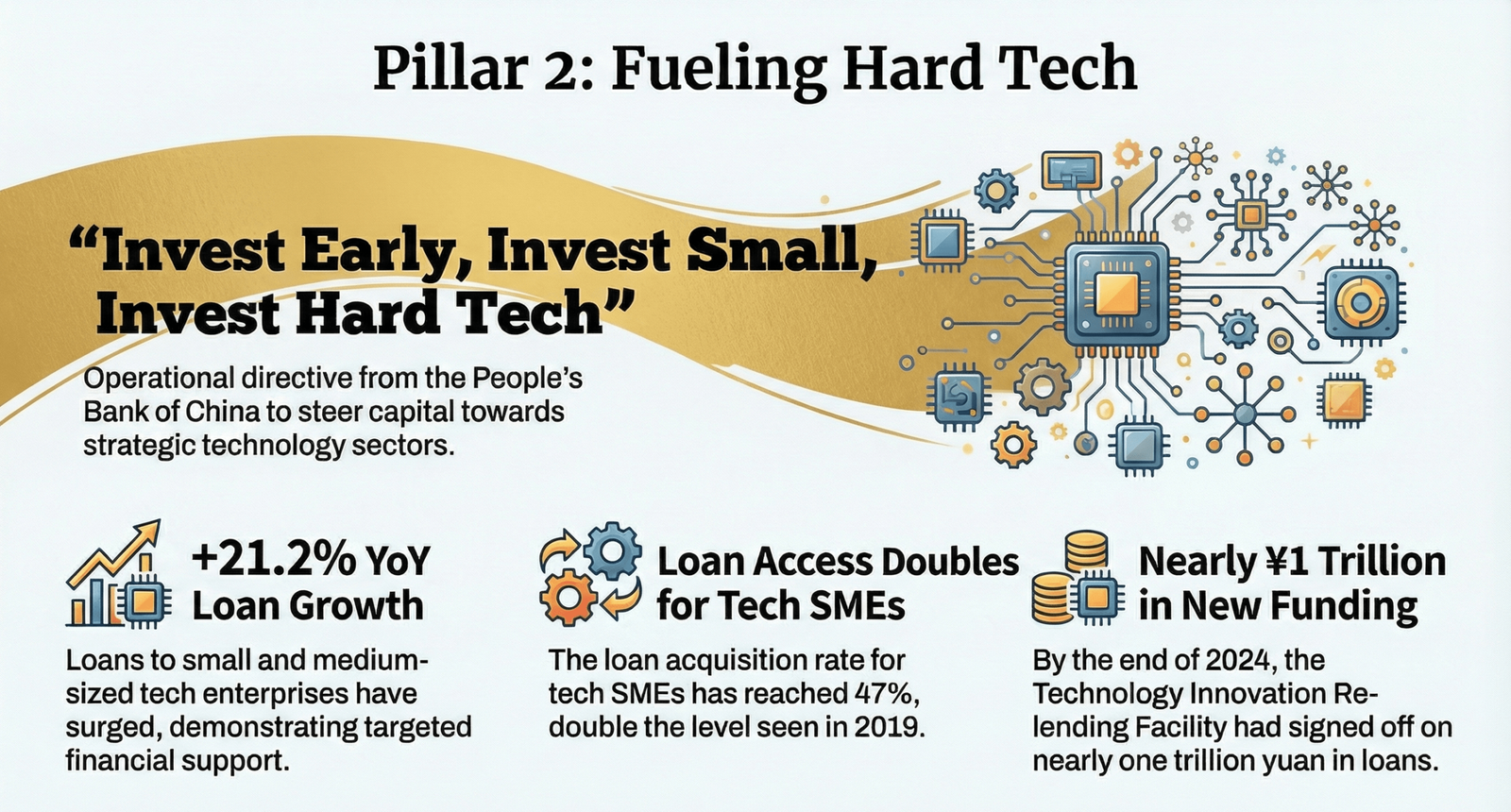
Beijing is moving decisively to steer capital towards strategic technology sectors. The PBOC instructs financial institutions to "invest early, invest small, invest long-term, and invest in hard tech." This is not mere guidance; it is an operational directive backed by significant financial firepower.
The report highlights key achievements and targets:
| Metric | Data Point |
|---|---|
| Technology Innovation Re-lending Facility | 500 billion yuan (established April 2024) |
| Total Loans Signed | Nearly 1 trillion yuan (by end of 2024) |
| Tech SME Loan Growth | +21.2% YoY |
| "Specialized, Refined, Distinctive, Innovative" Enterprise Loan Growth | +13.0% YoY |
| Tech SME Loan Acquisition Rate | 47% (2x the 2019 level) |
| Listed "Specialized" Enterprises on A-Shares | Over 1,900 |
 *AI generated for illustrative purposes.
The objective is to deepen the financial supply-side structural reform, moving beyond traditional lending to foster a robust venture capital ecosystem that supports a company's entire life cycle—from seed funding to market exit.
Pillar 3: Taming the Leviathan – The Market-Oriented Transformation of LGFVs
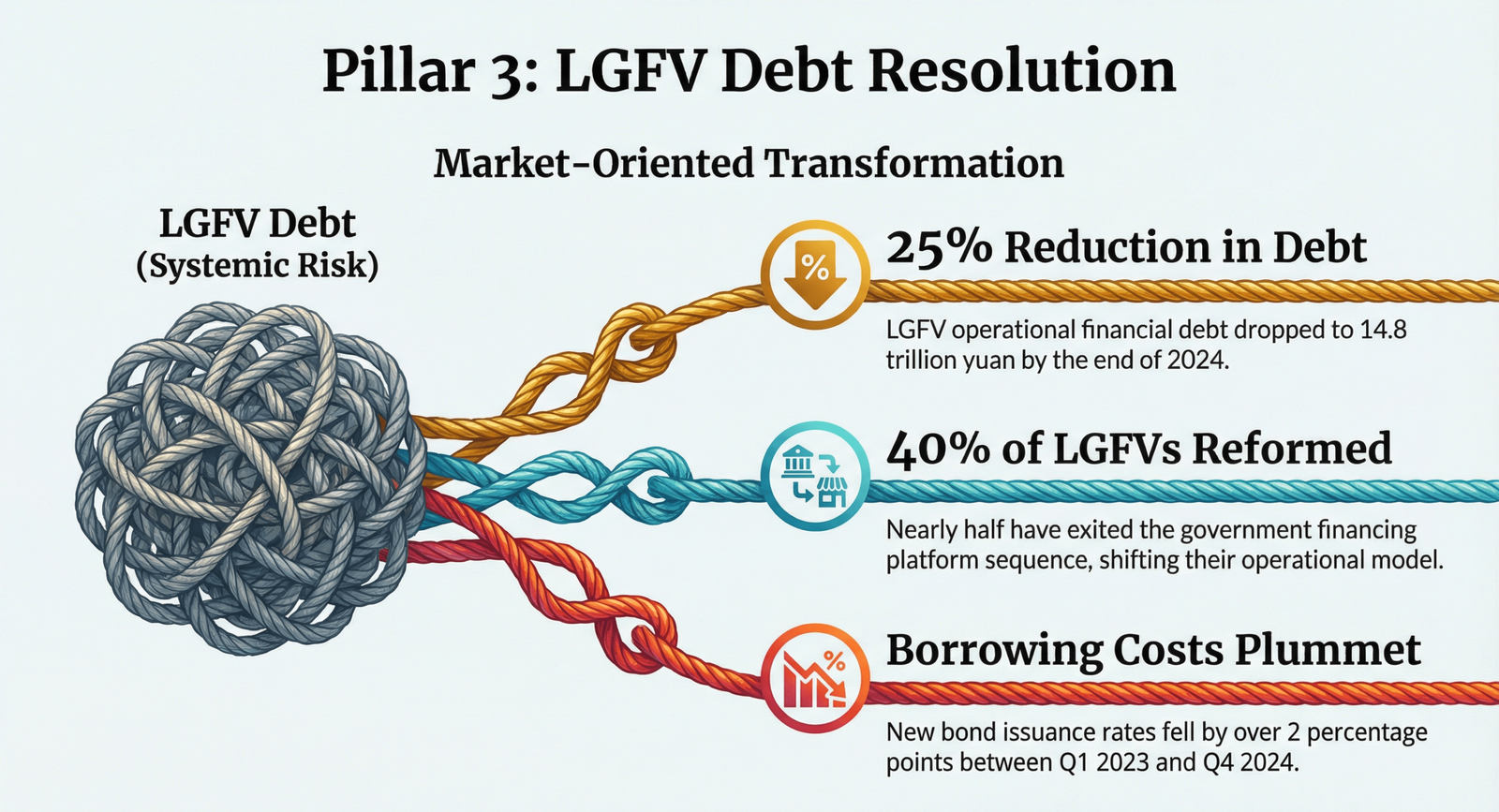
The report addresses the systemic risk posed by Local Government Financing Vehicle (LGFV) debt head-on. Regulators report significant progress:
| Metric | Data Point |
|---|---|
| LGFVs Exiting Platform Sequence | ~40% (by end of 2024) |
| LGFV Operational Financial Debt | 14.8 trillion yuan (down ~25% from early 2023) |
| New Bond Issuance Average Rate (Q4 2024) | 2.67% (down >2 pp from Q1 2023) |
 *AI generated for illustrative purposes.
This tangible reduction in risk demonstrates that the market-oriented transformation is producing results. The next step is to solidify this progress by guiding financial institutions to continue debt restructuring while ensuring financing remains available for critical projects—creating what the report calls a "virtuous cycle of debt resolution and development."
Pillar 4: The Managed Rate – Redefining Interest Rate Marketization
While affirming the goal of interest rate marketization, the PBOC introduces a nuanced approach focused on ensuring rates can both "form properly" and "be adjusted." The report acknowledges a critical issue: since the Loan Prime Rate (LPR) reform, banks' lending rates have fallen faster than policy rates, while deposit rates have fallen slower, severely squeezing net interest margins.
The report notes that commercial bank net interest margin stood at just 1.52% in 2024, with net profit declining 2.27% year-on-year. To counteract this, the PBOC will leverage the "interest rate self-discipline mechanism" to guide banks toward more rational pricing. This pillar signals a move away from pure market-driven rates toward a more managed system designed to protect bank profitability and, by extension, financial stability.
Pillar 5: The Value Mandate – CSRC Enforces Market Value Management
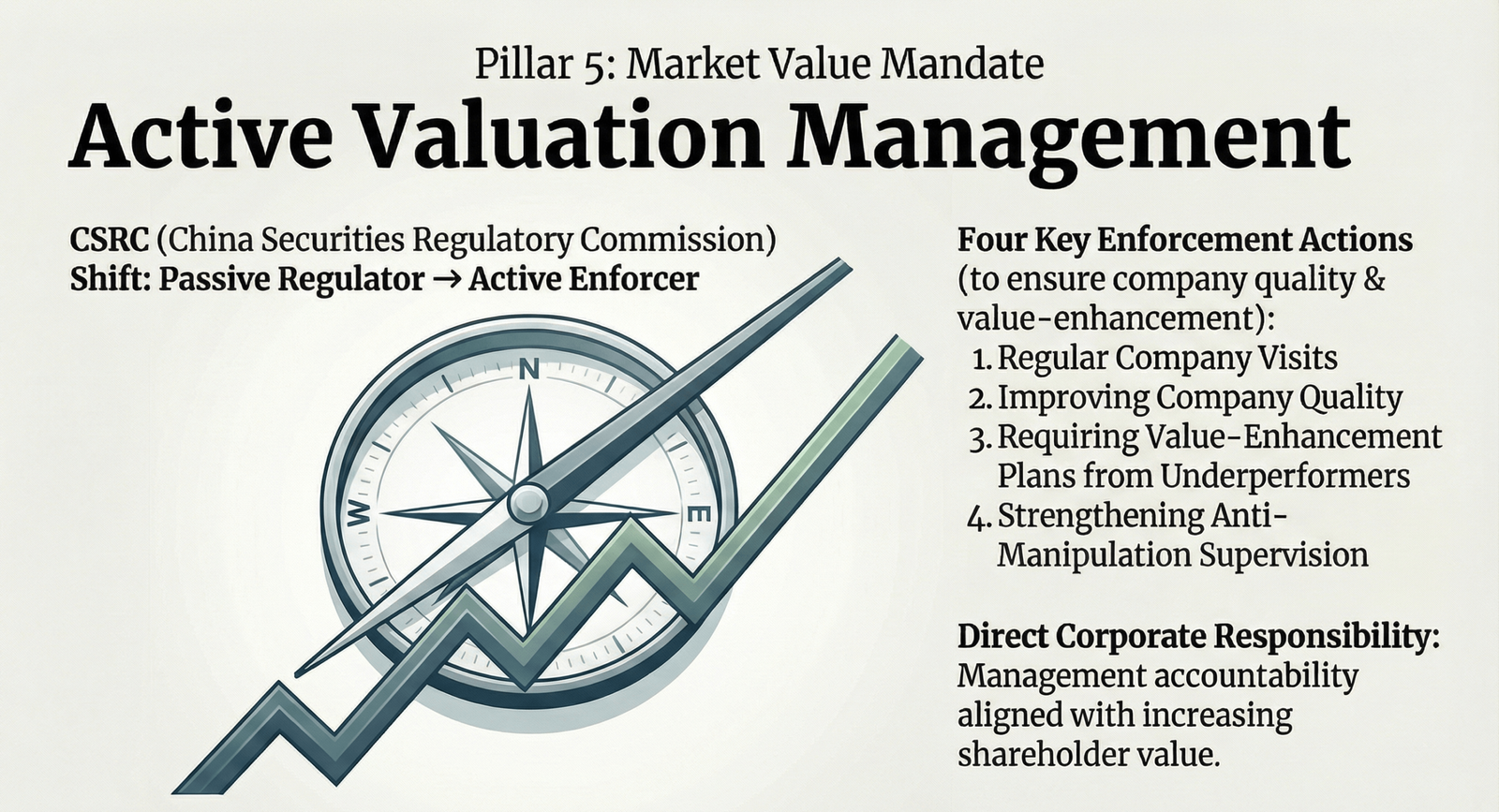
The China Securities Regulatory Commission (CSRC) is shifting its role from passive regulator to active enforcer of corporate value. The report details a new mandate for "market value management," compelling listed companies—particularly major index constituents—to actively manage their valuations.
The CSRC outlines four specific actions:
- Conduct regular visits to listed companies to understand difficulties and provide guidance.
- Implement multiple measures to improve listed company quality, including cracking down on financial fraud.
- Enforce main responsibility by requiring long-term "break-net" firms to create value-enhancement plans.
- Strengthen supervision to prevent market manipulation disguised as market value management.
 *AI generated for illustrative purposes.
This represents a fundamental change in corporate governance expectations, placing direct responsibility on company management to align their actions with shareholder value.
Pillar 6: WMP Liquidity – Probing for Hidden Contagion Risk
The report details liquidity stress tests conducted on nearly 14,000 mutual funds and 3,690 bank Wealth Management Products (WMPs) from 14 wealth management companies. While the results indicate that liquidity risk is "overall controllable," the PBOC's focus is clearly shifting.
The next step is to strengthen research into "cross-industry, cross-market" risk transmission paths. Regulators are concerned about the potential for shocks—such as bond yield spikes, stock market volatility, or credit defaults—to cascade through the interconnected WMP ecosystem. This forward-looking focus suggests that future regulations will likely target the complex interdependencies within China's massive 32.8 trillion yuan mutual fund market.
Pillar 7: The National Team 2.0 – Guiding Long-Term Capital into A-Shares
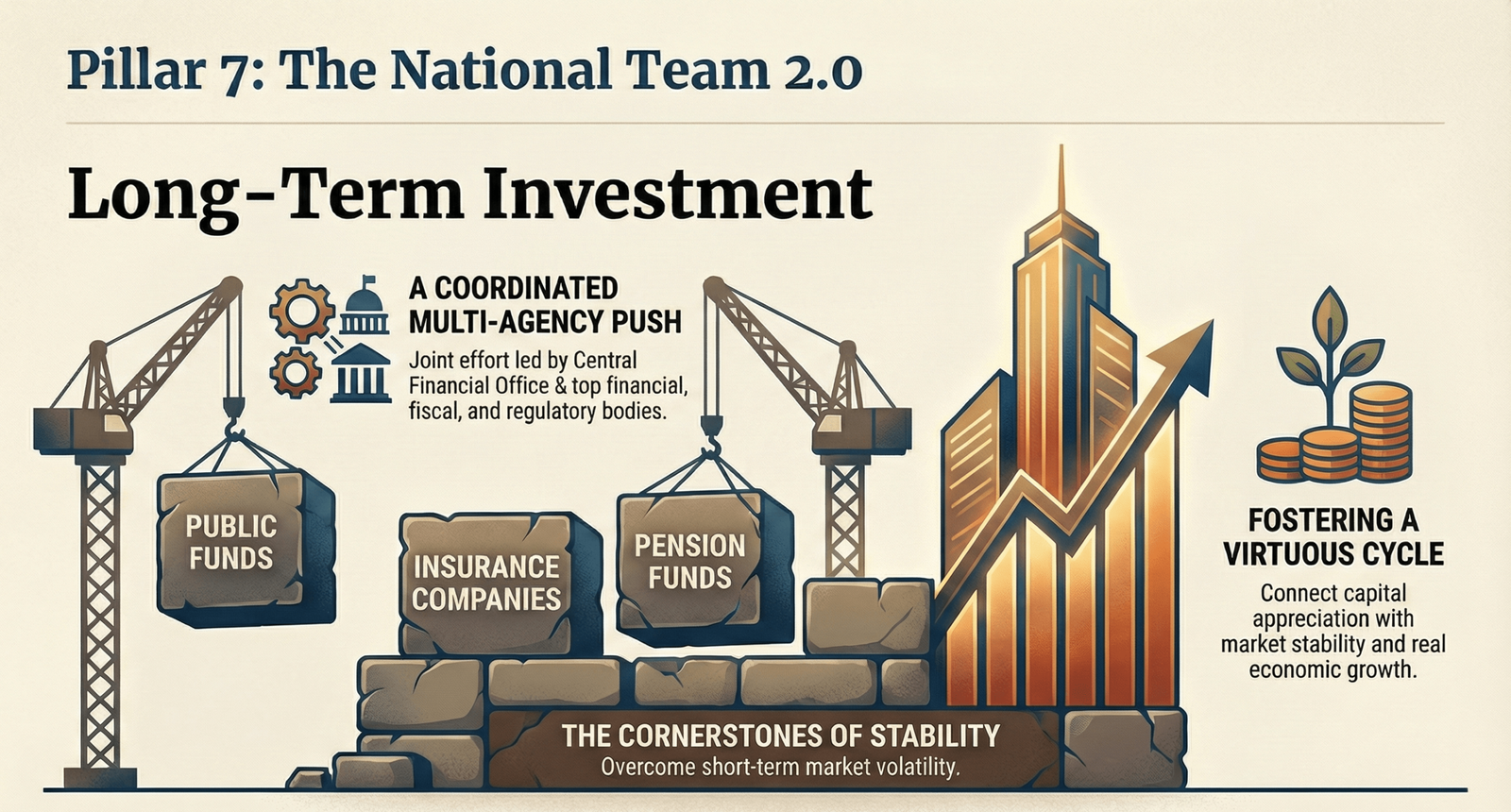
In a coordinated, multi-agency effort, Beijing is creating a policy environment explicitly designed to "significantly increase the scale and proportion" of long-term capital investing in the A-share market. Led by the Central Financial Office, agencies including the CSRC, PBOC, Ministry of Finance, Ministry of Human Resources and Social Security, and the National Financial Regulatory Administration will work together.
The stated goal is to create a framework that encourages "long-term investment for long-term holding." The report emphasizes that public funds, insurance capital, and various pension funds—with their stable sources and professional investment operations—can overcome short-term market volatility and serve as the cornerstone of healthy capital market development. The ultimate objective is fostering a virtuous cycle between capital appreciation, market stability, and real economic growth.
 *AI generated for illustrative purposes.
Pillar 8: The Central Bank's New Toolkit – Expanding Macroprudential Functions
The final pillar solidifies the PBOC's expanded role as the ultimate guarantor of financial stability. The report confirms the establishment of a new Macroprudential and Financial Stability Committee within the central bank in early 2025.
This committee will coordinate an expanding policy toolkit that now includes:
| New Tool | Function |
|---|---|
| Securities/Fund/Insurance Company Swap Facility | Provide liquidity support to non-bank financial institutions |
| Stock Buyback Re-lending Tools | Support listed companies in share buybacks and major shareholder increases |
| Enhanced Forex Market Framework | Improved "macroprudential + micro-supervision" approach |
This institutionalizes the central bank's ability to intervene directly to maintain market stability, moving beyond traditional monetary policy to embrace a more expansive and powerful macroprudential mandate.
Conclusion: A New Era of Coordinated Control
Taken together, these eight pillars represent a clear and coherent strategy. Beijing is not leaving financial stability to chance. The blueprint reveals a system moving toward greater centralization, more direct intervention, and a strategic alignment of financial policy with national industrial goals.
For market participants, the message is unequivocal: the rules of the game are being actively rewritten. Success will require a deep understanding of this new, coordinated playbook and the ability to adapt to a landscape where state direction and market forces are more intertwined than ever before.
References
[1] People's Bank of China Financial Stability Analysis Group. (2025). China Financial Stability Report (2025). China Financial Publishing House. PDF Link
[2] Tang, J. (2025, December 27). Central Bank Releases Major Report Clarifying Eight "Next Steps" for Financial Stability. 21st Century Business Herald. Article Link